
Tribal Program
Welcome and Purpose
Arizona Complete Health–Complete Care Plan (AzCH‑CCP) affirms the inherent sovereignty of Tribal Nations and recognizes Tribal governments as distinct, self‑governing partners. We acknowledge that Indigenous peoples have stewarded these lands since time immemorial and continue to sustain vibrant cultures, languages, and community systems that are foundational to health and well‑being. This acknowledgement reflects our responsibility to engage in respectful, transparent, and meaningful collaboration with Tribal Nations, consistent with a government‑to‑government relationship.
Arizona is home to 22 federally recognized Tribal Nations whose leadership and expertise are essential to advancing equitable, culturally grounded health systems. Tribal Nations are critical partners in addressing social determinants of health (SDOH) and health‑related social needs (HRSN), and AzCH‑CCP is committed to early, ongoing, and meaningful consultation to ensure Tribal priorities, perspectives, and self‑determined approaches guide program design, implementation, and evaluation. Through partnership rooted in mutual respect and shared goals, we seek to support community‑driven solutions that strengthen health, promote wellness, and sustain thriving Tribal communities for generations to come.
Federally Recognized Tribes in Arizona
- Ak-Chin Indian Community – Pinal County, Near Maricopa
- Cocopah Tribe – Yuma County, Near Yuma
- Colorado River Indian Tribes – La Paz County, Western Arizona
- Fort McDowell Yavapai Nation – Maricopa County, Near Fountain Hills
- Fort Mojave Indian Tribe – Mohave County, Western Arizona
- Gila River Indian Community – Maricopa/Pinal County, South of Phoenix
- Havasupai Tribe – Coconino County, Grand Canyon area
- Hopi Tribe – Coconino/Navajo County, Northeastern Arizona
- Hualapai Tribe – Mojave/Coconino County, Northwest Arizona
- Kaibab Band of Paiute Indians – Mojave County, Northern Arizona
- Navajo Nation – Coconino/Navajo/Apache County, Largest Tribe in the U.S., spanning Arizona, New Mexico, and Utah
- Pascua Yaqui Tribe – Pima County, Tucson area
- Quechan Tribe – Yuma County, Near Yuma, majority of reservation is in California
- Salt River Pima-Maricopa Indian Community – Maricopa County, Near Scottsdale
- San Carlos Apache Tribe – Gila/Graham County, East-central Arizona
- San Juan Southern Paiute Tribe – Coconino County, Northeastern Arizona
- Tohono O’odham Nation – Pima County, Southern Arizona near Tucson, borders Mexico
- Tonto Apache Tribe – Gila County, Payson area
- White Mountain Apache Tribe – Gila/Navajo/Apache County, East-central Arizona
- Yavapai-Apache Nation – Yavapai County, Verde Valley
- Yavapai-Prescott Indian Tribe – Yavapai County, Prescott area
- Zuni Tribe – Apache County, Small portion in Arizona (mainly in New Mexico)
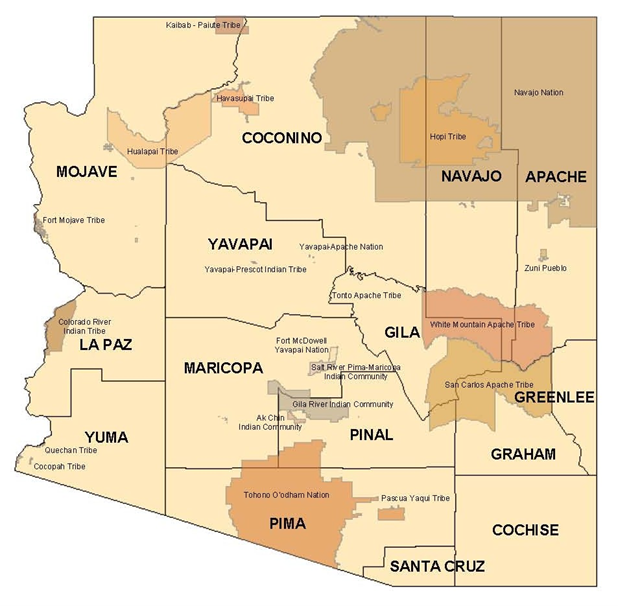
These Tribes often face SDOH/HRSN challenges such as housing, transportation, food security, utility, water, broadband, and access to culturally appropriate healthcare. Many initiatives in Arizona involve collaboration with the Inter Tribal Council of Arizona and Tribal health departments to address these needs. (ADHS, 2025)

Serving American Indian/Alaska Native AzCH-CCP Members
American Indian Members have a variety of options they can choose from for their physical and behavioral health care needs:
- American Indians can switch between the American Indian Health Program (AIHP, a fee-for-service program) and an AHCCCS Complete Care plan at any time of the year.
- American Indian Members enrolled with AzCH-CCP can access services from an Indian Health Service or Tribal 638 facility at any time.
AzCH-CCP Care Management Referral
AzCH-CCP’s Care Management Department supports the coordination of care for our members by screening for social determinants of health screening and resource referring to community or provider resources. For further assistance or to refer a member, please call us at 1 (888) 788-4408 (TTY/TDD: 711). Monday-Friday 8 a.m. to 5 p.m. local time/MST.
AzCH-CCP Tribal Programs
AzCH‑CCP’s Tribal Programs team advances equitable access to services through respectful collaboration and coordinated care with Tribal Nations and Tribal health systems in support of American Indian/Alaska Native members. We work in partnership with Arizona Tribal Nations, Indian Health Service, and Tribal 638 providers to identify service needs and gaps and to co‑develop solutions that are community‑driven, culturally responsive, and aligned with Tribal priorities.
The Tribal Programs team facilitates ongoing coordination of care between the managed care system and Tribal health systems to support whole‑person care, continuity of services, and culturally appropriate care planning. The team includes Tribal Liaisons serving Northern and Southern Arizona and a Tribal Clinical Services Coordinator who partners closely with Tribal and non‑Tribal providers, care management teams, and community supports to promote seamless communication, safe transitions of care, and shared accountability for member health and well‑being.
For additional support related to Tribal coordination of care, collaboration, or care transitions, please contact AzCHTribalCOC@azcompletehealth.com.
National & Arizona Tribal-Specific Hotlines
- StrongHearts Native Helpline
24/7 confidential, culturally appropriate support for Native American and Alaska Native survivors of domestic, dating, and sexual violence.
1-844-7NATIVE (1-844-762-8483) | strongheartshelpline.org - National Indigenous Women’s Resource Center (NIWRC)
Provides resources and connects survivors to culturally grounded support.
1-844-7NATIVE | niwrc.org - Gila River Indian Community Domestic Violence Crisis Line
1-855-203-5849 – Emergency shelter, crisis intervention, advocacy. - Tohono O’odham Nation – Komckud Ki Domestic & Sexual Violence Prevention Program
1-866-666-4889 – Confidential behavioral health and DV support. - Salt River Pima-Maricopa Indian Community Crisis Line
1-855-331-6432 – Family Advocacy Center services. - Northern Arizona Tribal Communities Crisis Line
1-833-990-6400 - Hopi Tewa Women’s Coalition to End Abuse
Facebook Page – Advocacy and support for Hopi communities.
Missing and Murdered Indigenous Persons (MMIP) Support
- BIA Missing and Murdered Unit Tip Line
833-560-2065 | Text BIAMMU and your tip to 847411
Provides assistance and coordinates investigations for MMIP cases. - National Indigenous Women’s Resource Center – MMIW Toolkit
niwrc.org/mmiwtoolkit – Guides for families and communities.
Culturally Responsive Care and Respect
AzCH-CCP believes that effective health communication is as important to health care as clinical skill. Healthcare providers must recognize and address the unique cultural, language, and health literacy of members and communities to improve individual and community health.
Cultural Competency encompasses our Health Plans beliefs, values, and commitment to culturally responsive care improving the health of the community. It is the ability to interact effectively with people from different cultures and backgrounds by learning about and honoring the diverse cultures of those you work with. Better intercultural and linguistic communications can play a role in reducing health disparities which are prevalent throughout Arizona and the nation (Think Cultural Health, 2025).
Culturally appropriate care for Tribal Nations, American Indian, and Indigenous peoples begins with building trust and respect by acknowledging historical trauma and approaching care with humility. Listening to patient concerns, respecting traditional healing practices, and providing space for spiritual activities such as smudging or prayer are essential. Communication should be clear and culturally sensitive, using interpreters when needed and honoring oral traditions. Care plans should be person-centered, adapted to Tribal customs, and involve family or community when appropriate, recognizing diversity among Tribes rather than applying a one-size-fits-all approach.
Healthcare organizations should train staff on Tribal history, cultural values, and implicit bias while implementing the National CLAS Standards to ensure equitable and respectful care. Practical actions include offering flexible visiting hours for elders, incorporating traditional foods into dietary plans, and partnering with Tribal health programs for outreach. These steps foster culturally responsive care that addresses health disparities and strengthens trust between providers and Indigenous communities.
Whole Person Care and Related Resources
AzCH-CCP partners with AHCCCS to support AHCCCS’ Whole Personal Care Initiative (WPCI), a system innovation in integrated health care delivery to address social risk factors of health—commonly referred to as Social Determinants of Health (SDOH)—which impact a member’s health and well-being. To learn more, visit:
- AHCCCS Whole Person Care Initiative (WPCI)
- WPCI Resources
- Arizona Department of Health Services – Tribal Liaison
- AHCCCS Tribal Relations
Member Languages and Interpreters: For further language access information, please visit the AzCH-CCP Member Languages and Interpreters webpage.
Provider Training and Workforce Development (health advancement): for further information, please visit provider resources.
Drivers of Health (DOH) in Tribal, Indigenous, Alaska Native Communities
Drivers of Health (DOH)—also known as Social Determinants of Health (SDOH) or Health-Related Social Needs (HRSN)—are the social, economic, and environmental conditions that shape health outcomes. These include the conditions in which people are born, grow, live, work, and age, shaped by the distribution of money, power, and resources at global, national, and local levels.
For Arizona American Indian, Indigenous, and Alaska Native populations, DOH are deeply connected to historical and systemic inequities, including:
- Historical trauma from colonization, forced relocation, and cultural suppression.
- Jurisdictional barriers in accessing healthcare across Tribal, state, and federal systems.
- Geographic isolation, limiting access to specialty care, healthy food, and transportation.
- Economic disparities, with higher rates of poverty and unemployment in many Tribal communities.
Why It Matters for Tribal Health Programs
- Whole Person Care: Addressing SDOH is critical to reducing disparities in chronic disease, behavioral health, and maternal health outcomes.
- Cultural relevance: Tribal communities experience unique social needs, such as cultural connectedness, language preservation, and community safety.
- Policy and funding: Accurate documentation of SDOH through ICD-10 Z-codes and Tribal-specific H-codes supports advocacy for resources and funding for Tribal health programs.
Health-Related Social Needs (HRSN)
HRSN are the immediate, non-medical needs that impact health and well-being, such as:
- Safe housing and utilities
- Access to healthy food
- Reliable transportation
- Employment opportunities
- Personal and community safety
For Tribal, Indigenous, and Alaska Native communities, HRSN may also include:
- Access to traditional foods and medicines
- Cultural and spiritual support
- Protection from violence, including Missing and Murdered Indigenous Persons (MMIP) concerns
Screening Tools Tailored for Tribal Populations
- PRAPARE (Protocol for Responding to and Assessing Patients’ Assets, Risks, and Experiences) – can be adapted for Tribal cultural contexts.
- IHS SDOH Assessment Tool – developed for Indian Health Service facilities.
- Tribal-specific surveys incorporating cultural identity, historical trauma, and community safety.
Closed-Loop Referral System
American Indian Culturally Responsive Training Available on Relias
| Module ID | Module Name | Description |
|---|---|---|
| AzCH100 | American Indian Service Systems | Overview of available options for American Indians to access behavioral health and physical health services (i.e. Indian Health Services, Tribal 638 facilities, Regional Behavioral Health Authority (RBHA) providers, Tribal RBHA). |
| AzCH131 | AZCH Effective Engagement of American Indians in Behavioral Health Services | Overview of American Indian history within the United States, American Indian culture and customs, traditional healing services and tips for working with American Indian members. |
| CBH156 | Tohono O’odham History & Culture | Video recording of a Tohono O’odham tribal member delivering a presentation on the history and culture of the O’odham people. |
| AzCH105 | AzCH-MMWIA- Colorado River Indian Tribes (CRIT) | Overview of the Tribal MMWIA initiative, which took components of the MMWIA program and applied cultural considerations of the Colorado River Indian Tribes. Developed in partnership with Tribal stakeholders. |
| AzCH104 | AzCH-MMWIA-San Carlos Apache Tribe (SCAT) | Overview of the Tribal MMWIA initiative, which took components of the MMWIA program and applied cultural considerations of the San Carlos Apache Tribe. Developed in partnership with Tribal stakeholders. |
| AzCH100 | AzCH-MMWIA-Tohono O’odham (TON) | Overview of the Tribal MMWIA initiative, which took components of the MMWIA program and applied cultural considerations of the Tohono O’odham Nation. Developed in partnership with Tribal stakeholders. |
- CommunityCares: Arizona’s Statewide Closed-Loop Referral System
- Contexture: Arizona’s Social Determinants of Health Referral System, CommunityCares
AzCH-CCP encourages usage of SDOH screening tools available through or compatible with CLRS to screen members for social risk factors of health based upon the provider’s business needs. To learn more:
Tribal-Specific H-Codes
Tribal-specific H-codes are emerging diagnostic codes designed to capture health factors unique to Indigenous communities that standard ICD-10 codes do not address. These include conditions related to historical trauma, cultural disconnection, and risk factors for Missing and Murdered Indigenous Persons (MMIP). Documenting these codes helps Tribal health programs track culturally relevant health drivers, advocate for resources, and design interventions that honor Tribal sovereignty and lived experiences.
- H-codes address issues unique to Indigenous populations, such as:
- H0053 - Historical trauma
- H0052 - MMIP-related risk factors
- These codes help capture culturally specific health drivers that standard Z-codes may miss, ensuring Tribal health programs can track and respond to these critical issues.